
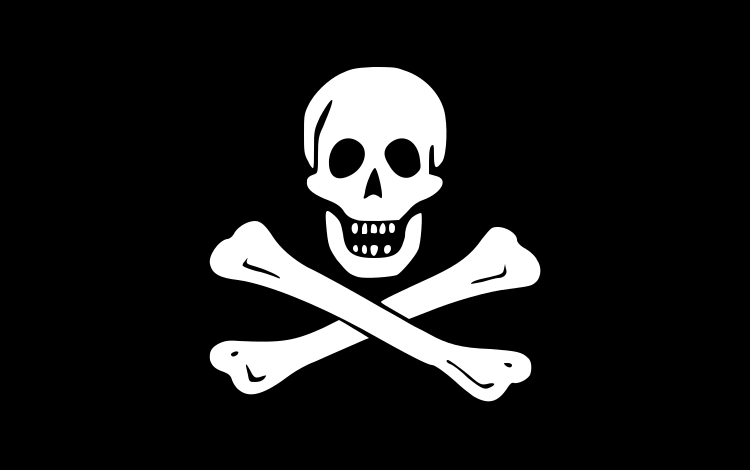
Eventually, free music became the norm. Music was now a digital medium, with small MP3 files that could be so easily transferred through CDs, the internet, and the fancy new iPods and (then) competing MP3 players.
What I didn't expect was how quickly it began to happen to movies, video games- and basically anything could be stored in digital form. At the time, it seemed like there were a number of excuses for why it was OK to pirate music. Music was so small (in both size and cost), it was all available on the radio, performers get most of their revenue during concerts- not to mention they were probably rich to begin with... and the list goes on.
Movies and video games were gigabytes larger than music- so with the slower internet they were much more of an inconvenience to attain. As soon as this bandwidth became available, the piracy trend began to spread across all digital mediums. More expensive digital works were now also becoming easily freely available, and it was becoming clear that few ethics actually guided people's thoughts about pirating: that is, if you can get it free, you'll take it. It is a social norm, and people rarely think twice about it nowadays.
Naturally, worried corporations have begun to look for ways to protect their intellectual property; rightfully so, in my opinion. However, they often fail at finding a reasonable balance between this and customer satisfaction. Personally, I've always had a long-standing interest in video game development, so piracy often brings to mind the numerous successes and failures of applying DRM in the video game industry.
Publishers have tried using CD-codes (The Sims), limited installs (Spore), a constant internet connection (Splinter Cell Conviction), but none of these have prevented piracy- that is, people will always hack around it, and then share it.

Furthermore, they estimated that only 1 of 1000 people who downloaded a game would have bought it otherwise. So, does DRM justify itself? For the end purpose of increasing revenue, and given that it is both ineffective and doesn't significantly increase sales, I'd say probably not.
Different companies have tried alternative approaches to DRM, such as Valve with Steam. Steam really is a DRM service, since games need to be activated on-line before playing, but this isn't a huge burden since most computers are able to get internet access at some point. However, Steam provides benefits for people who properly own the game. The user has access to a community of friends, playing and managing multilayer games is simplified , stat-tracking and public achievements are available. Not to mention, that once a game is associated with your account, you can download it through the internet onto as many computers as desired. Finally, it includes an offline mode, which is fair.
It seems sometimes the best counter-measure for piracy is to provide benefits for owning a real copy, through digital community and services, and make buying legit copies easier than pirating. I'll have to do some further research, however, to fully assess the impact of piracy, and perhaps statistically back up these claims. It does seem that since the explosion of Steam and other distribution services, PC gaming has started to rise again after a decline over the last few years (which some attribute to the ease of PC game piracy), but I'll save this topic for later.
(Images from Wikipedia)

I don't believe that piracy is a problem. I think it is a solution to a problem, and that is the archaic business models that publishers and labels are used to, and afraid to change.
ReplyDeleteIt is my belief that piracy isn't necessarily theft. Imagine that I download a game and try it. Since I liked it so much, I decide to buy the game. The result is that, I pirated the game, but I bought it. So it wasn't theft.
If I download a game and don't like it, I don't buy it. Then that means I pirated a game, but did not keep it. Which means I am a pirate, but didn't steal it because I didn't keep the copy. In other words, the publisher didn't impress me enough to justify giving them money.
Finally, if I download a game and like it, but don't pay the publisher. That makes me a pirate and a thief.
See the difference? It's for that reason that other indies like Team Meat don't give f**k about piracy.
http://www.cinemablend.com/games/Super-Meat-Boy-Developer-We-Don-t-F-cking-Care-About-Piracy-33604.html
Yeah, the good thing about piracy is that it does spread content around to people who may otherwise have never seen it. More popularity is always a good thing.
ReplyDeleteThe actual impact of piracy may or may not be a big issue, but it does make a difference. It seems like a lot video rental stores are shutting down, for better or for worse.
The idea of using piracy to try a game before you buy it is valid, but I honestly don't think many people do that. I know a lot of people who pirate games, play them right through to the end, and never actually buy the game.
I forget where I read it, but someone before described paying for indie games as being "hip" right now. Personally, I really like the direction indie video games have taken and would love if this more personalized mentality of not paying for the game, but giving to the developers, stays and lasts. But I can't say if it will, or is viable as a mainstream model.
It does remind me of good 'ol shareware DOS games though, where you got the whole game, and then payed if you liked it. However, shareware games didn't really last. There might be many reasons why this happened, but I can't help but think that it might have been because less people actually bought the games.
IMO, DRM is just completely unnecessary. As you've said, its been shown countless times that it has pretty much no effect on piracy rates. Most of the time all it ends up doing is hurting the experience for the people who actually bought the game, and making things more inconvenient for them. This is actually the main reason I never bought Splinter Cell Conviction. I absolutely LOVE the Splinter Cell series, but I refuse to accept that I cannot play the damn game when I'm not connected to the internet!
ReplyDeleteThe publishers seem to think that all the added DRM will lead to them having more sales of the game, but personally, I'd be MUCH more inclined to support a company and buy their game (if I liked it of course) if it had no DRM, than if it did.
Recently, the Witcher 2 devs announced that they are done with DRM forever. I think that's pretty awesome, and a step in the right direction:
http://www.joystiq.com/2012/03/08/witcher-2-publisher-we-will-never-use-any-drm-anymore/
Oh yea, and I just gotta say in response to the "scary" piracy video.. I love this spoof from the show IT Crowd :D
ReplyDeletehttp://youtu.be/xuxO6CZptck
XD That's a pretty great spoof.
ReplyDeleteThat's great the Witcher is dropping DRM. Already, I have an old piece of software that requires internet activation, but the company doesn't support it any longer, so it won't activate. This is pretty unfair.
I can't imagine what will happen if Steam ever goes out of business.
Last semester we had a guest lecturer come in to talk on this subject who actually works in the copyright industry. He described piracy as basically a result of a failing commercial market. It's simply a competing product with no particular company behind it, if you will.
ReplyDeleteIn the case of movie rental stores starting to die off, this is just because they're trying to hold on to an old, outdated distribution system - people don't want to leave their house when a much service called the internet is provided right in their home. We've seen a shift towards products like on-demand cable/satalite, iTunes, and netflix - and I think its safe to say that these products are the real culprits (or at least very large contributes) for shutting down physical dvd rental stores.
Yet still, these are not good enough - anyone who's tried netflix knows how limited its selection of movies is, iTunes tends to be very exclusive to the Apple world with most songs contain annoying DRM that won't let me put the music on my android until I manually remove it, and there's lots of other problems like "services not being available in your country". It's not even that people just want the products for free (like you said, people really like to give money to the creators, especially when the middle man is cut out in the case of indie companies), it's that the commercial market is failing to provide any better services.
I will admit however that this might not be entirely true. There are some pretty great options , I think steam is great - it's much easier to buy a game and have it automatically maintained and updated through Steam rather than downloading and cracking a pirated version.
I really think the best bet for companies in general is to just drop the DRM since it just causes problems for those who buy the produce legitimately, while those who pirate it already have the annoying stuff hacked out for them. It definitely seems to drive people away more than anything. Instead, focus on making a something that's better than the piracy alternative - like steam! :D
..... yes i know steam still has drm... but, it's not annoying and getting in the way (at least from my experience).
Hmm, so you say that some people pirate because the existing services are insufficient. This might be a large factor, however I still can't shake the feeling people pirate because it's free; but I can't really support that claim. Although, I think it is well agreed we need to get rid of DRM because it's useless :)
ReplyDeleteNo, you're right - I'm sure there are some people that pirate because it's free. In this case I think a lot of the time it isn't a lost sale though. For example, I've downloaded Flash before for the sole reason of it being free, not because it was easier (in fact its pretty annoying - you have to block the authentication sites and whatnot). However, there's no way I would have paid the rather large price for Flash either way. So really, adobe wasn't affected besides the fact that they got some free advertising to me.
ReplyDeleteBut then again, not everyone is the same - I think there's too many different factors to definitely say either way. I'm sure what I've said is true for a large number of people, but also that many people just do it because they're cheap.